
What players say
Penguin Flight Puzzle Adventure builds its challenge around predictable physics and limited attempts. The penguin reacts consistently to walls, ramps, and moving platforms, so success comes from reading the level and planning a route. Early stages teach the basics, while later ones combine obstacles to demand more precise timing. The calm visuals and lack of time limits suit players who prefer thoughtful puzzle solving over reflex-driven arcade play. The main limitation is that the concept stays close to its core loop, so players seeking constant variety may find it repetitive.
About this game
Launching a Penguin with Physics
Each level in Penguin Flight Puzzle Adventure starts with a simple decision: how hard and at what angle to send the penguin flying. The game simulates gravity and collision, so the penguin behaves predictably once it leaves the launcher. It will bounce off walls, slide along ramps, and react to any surface it touches. That predictability is the point. You are not fighting random outcomes; you are reading the layout and choosing a launch that uses the environment instead of ignoring it.
Reading the Level Layout
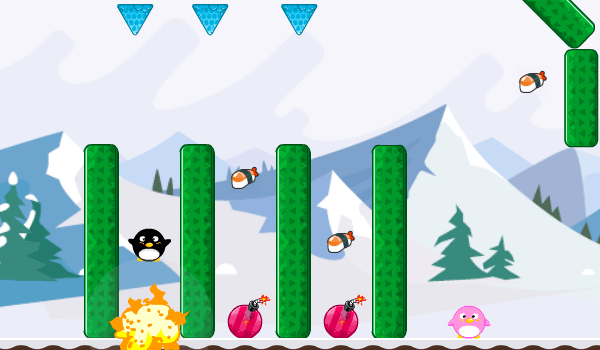
Obstacles come in several forms. Blocks sit in the penguin's path, ramps redirect momentum, and moving platforms shift position over time. Some obstacles rotate or slide, which means the same launch can succeed or fail depending on when you release it. Early levels keep the arrangement simple so you can learn how the penguin reacts to a single bounce or slope. Later levels stack these elements together, and the solution often depends on chaining two or three interactions in one launch. Because the game rewards creative solutions, there may be more than one valid route to the sushi.
Limited Attempts and Deliberate Play
You have a limited number of attempts per level. That constraint changes how you approach the screen. Instead of firing immediately, you study the geometry, estimate where the penguin will land, and decide whether a direct shot or a banked shot is more reliable. The aim-launch-observe loop becomes a cycle of small adjustments: change the angle slightly, add a bit more power, see where the penguin ends up. When a launch fails, the feedback is immediate and specific, which makes the next attempt more informed.
Presentation and Pace
[IMG_0] The penguin is expressive, and the sushi targets add a playful touch to each stage. Backgrounds stay simple and calm, which keeps attention on the puzzle rather than the scenery. Sound effects mark each launch and collision without overwhelming the experience. There are no time limits, so you can experiment at your own pace. That makes the game suitable for short sessions or longer play, and the gradual difficulty curve means new players can build confidence before the layouts become genuinely tricky.
Compatibility
FAQ
Player comments
Sign in to comment
You must be logged in before posting a review or rating.
No comments yet. Be the first to comment!






Editorial Notes