
What players say
Cooperative Team Puzzle Game builds its challenge around information sharing rather than dexterity. One player collects gold to produce a key; the other sees and triggers invisible levers that reshape the level. The result is a steady loop of description, planning, and synchronized movement. The non-violent design and simple controls suit families and casual co-op sessions, while the portal-escape structure gives each level a clear endpoint. The main limitation is that the experience depends entirely on having a second player available.
About this game
Two Roles, One Goal
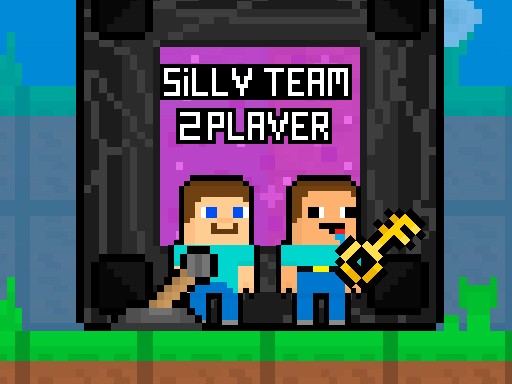
Cooperative Team Puzzle Game assigns each player a distinct role. The gold collector moves through the environment gathering pieces scattered across the level. The second character perceives invisible levers that remain hidden to the partner. Activating a lever triggers a visible change: a bridge appears or an iron door slides open. Neither role can finish alone, so progress depends on sharing what each player sees and needs.
Gold, Keys, and Hidden Switches
Collecting enough gold produces a key. That key is not the final step; it signals that the team can now pursue the chest. Meanwhile, the lever operator must locate and activate the switches that make the chest reachable. The sequence matters. A bridge revealed too early may lead nowhere until the key exists, and a key without an open path is equally useless. Players coordinate timing as much as movement.
Escaping Through the Portal
Once both players reach the chest and open it, a portal appears. Entering the portal completes the level. The portal only becomes visible after the chest is opened, so both players must be positioned to enter together. This final step reinforces the game's emphasis on synchronized action rather than individual speed.
Designed for Communication
The puzzles avoid overly complex logic, keeping the challenge focused on clear communication. One player describes what they see; the other describes what they can activate. That back-and-forth is the core mechanic. The non-violent presentation and simple controls make it suitable for younger players, while the coordination demands still engage adults looking for a short cooperative session.
Compatibility
FAQ
Player comments
Sign in to comment
You must be logged in before posting a review or rating.
No comments yet. Be the first to comment!



Editorial Notes