
What players say
Yellow Ball Aim Puzzle strips aiming down to a single decision: when to release. The rotating white ball and eight-position yellow target create a narrow timing window, and three misses end the run. That structure suits short sessions and players who enjoy reflex tests. The minimal visual design keeps attention on the mechanic, but the lack of variety may limit long-term appeal for those seeking deeper progression.
About this game
Core Aiming Mechanic
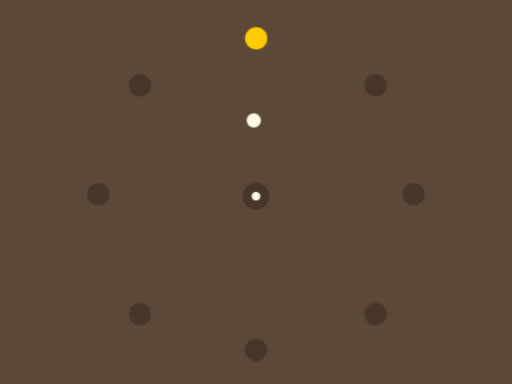
Yellow Ball Aim Puzzle places a white ball at the center of a circle. That ball rotates continuously around its axis, and a yellow target ball occupies one of eight positions along the circle's edge. You tap or click to release the white ball toward the target. The only input is timing. No aiming stick, no trajectory preview, no second chance within a single shot. The white ball's rotation speed and the yellow ball's position create a narrow window for a successful hit. Missing consumes one of three attempts. When all three are gone, the run ends.
Moment-to-Moment Decisions
Each round asks the same question: when to release? The yellow ball sits at a fixed point among eight, but the white ball keeps moving. You must judge the angle where the rotating white ball will align with the stationary target, then tap at that exact moment. After a successful hit, the yellow ball resets to a new position, and the cycle repeats. The challenge is not learning new rules but refining your internal timing. Small errors in reaction speed compound quickly, and the three-attempt limit means every miss matters.
Visual Clarity and Session Length
The visual design is deliberately minimal. A white ball, a yellow ball, a circle, and eight target points. Nothing else competes for attention. That simplicity serves the mechanic: with no visual noise, your focus stays on the rotation and the target. Rounds are short, often lasting only as long as your three attempts. This makes the game easy to pick up for a few minutes and equally easy to set down. The difficulty may increase as you improve, though the core loop remains unchanged.
Who This Suits
Players who enjoy precision timing and quick reflex tests will find the loop straightforward. Those who prefer puzzle-solving with multiple solutions or narrative context may find the single-mechanic structure too narrow. The game does not offer complex rules or distractions. It asks for concentration and delivers a clear pass-or-fail result each round. Practice is the primary route to improvement, and the three-attempt limit encourages careful observation before committing to a shot.
Compatibility
FAQ
Player comments
Sign in to comment
You must be logged in before posting a review or rating.
No comments yet. Be the first to comment!





Editorial Notes